Week 1
The Truth About Your Digital Life
What your phone is really doing to your brain, why willpower won't fix it, and the science that will.
This week is free. If the program resonates after this, the remaining 11 weeks are yours to unlock.
Mara's Morning
Mara's alarm went off at 7:15 AM on a Tuesday. She reached for her phone — she always reached for her phone — and opened Instagram. Just to check. Then she opened email. Then Twitter. Then back to Instagram because new stories had loaded in the four minutes since she last checked. Then the news. Then a group chat. Then a YouTube video someone had linked, which led to another video, which led to a rabbit hole about a topic she would not remember by lunchtime.
At 8:43 AM, she looked at the clock and felt a familiar wave of something between guilt and confusion. An hour and twenty-eight minutes had passed. She was still in bed. She had not eaten, had not showered, had not spoken to the partner sleeping next to her. She could not, if pressed, recall a single specific thing she had read or watched. It was all a blur — a warm, numbing blur of content that left her simultaneously overstimulated and empty.
Mara got up, made coffee, and opened her screen time app out of morbid curiosity. Yesterday: 5 hours and 12 minutes. The day before: 4 hours and 48 minutes. Average for the week: 5 hours and 3 minutes.
Five hours a day. Thirty-five hours a week. That was nearly a full-time job spent on her phone. And she could not account for any of it. Not a single hour had been planned, chosen, or meaningful. It had just... happened. Like a blackout, but with her eyes open.
Mara is not unusual. She might be you. And over the next 12 weeks, we will follow her journey alongside yours — because sometimes, seeing yourself in someone else's story is the clearest mirror there is.
The Economy of Your Eyes
Here is the first truth, and it is the foundation everything else in this program is built on: your attention is the most valuable resource in the modern economy, and you are giving it away for free.
This is not a metaphor. It is a business model.
The largest and most profitable companies in human history — Google, Meta, TikTok's parent company ByteDance, Twitter/X — do not sell you a product. You are the product. More precisely, your attention is the commodity, and it is sold to advertisers in real-time auctions that happen billions of times per day. Every second you spend on a platform is a second that can be monetized. Every scroll, every click, every extra minute you linger on a post before moving on — all of it is measured, optimized, and converted into revenue.
This means that the apps on your phone are not designed to serve you. They are designed to capture you. There is a fundamental misalignment between what you want (useful tools, meaningful connection, entertainment that enriches your life) and what the platform wants (your attention, for as long as possible, as frequently as possible, regardless of how it makes you feel).
Tristan Harris, a former design ethicist at Google and co-founder of the Center for Humane Technology, has spent years making this point:
"The problem is not that people lack willpower. The problem is that there are a thousand engineers on the other side of your screen whose job is to break down whatever willpower you have."
When you feel unable to put your phone down, you are not failing. You are encountering a system designed by some of the most talented psychologists, neuroscientists, and engineers in the world, armed with real-time behavioral data about billions of users, and optimized through millions of A/B tests to be as compelling as possible.
Let that sink in. You — one person, with one brain, limited willpower, and no instruction manual — are matched against a machine built by thousands of experts with billions of dollars. And when you lose, you blame yourself.
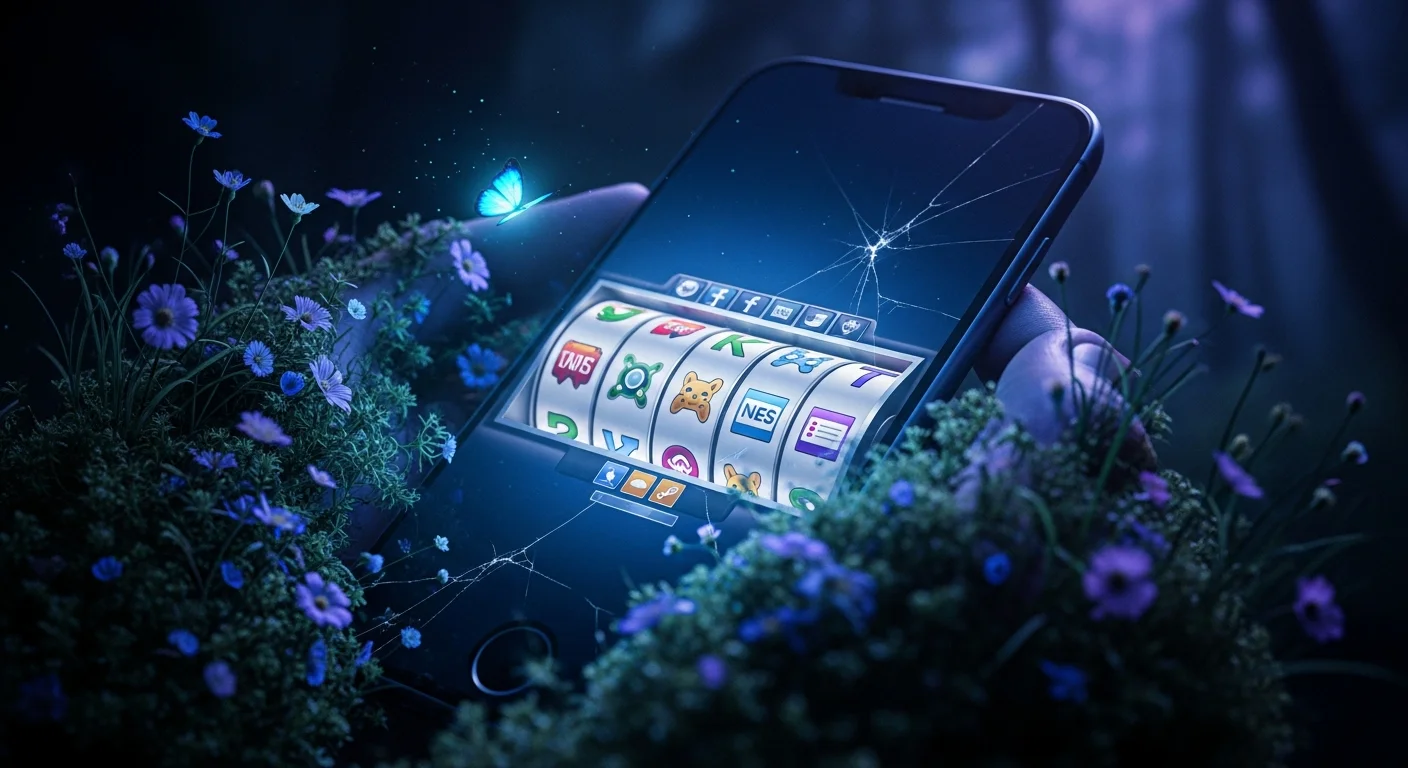
The Slot Machine in Your Pocket
The core mechanism is what behavioral psychologists call variable intermittent reinforcement. In plain language: unpredictable rewards.
B.F. Skinner demonstrated in his foundational operant conditioning research (1950s) that the most powerful way to reinforce a behavior is not to reward it every time, but to reward it sometimes, unpredictably. A rat that gets a pellet every time it presses a lever will press the lever when it is hungry and stop when it is full. A rat that gets a pellet randomly — sometimes on the first press, sometimes on the twentieth — will press the lever compulsively, endlessly, even when it is not hungry.
Your phone is the lever. The pellet is dopamine.
Every time you open Instagram, you might see something that makes you feel good — a funny post, a compliment, a like on your photo. Or you might see nothing interesting at all. You never know which. So you keep checking. The unpredictability is the engine. If social media were reliably boring, you would stop using it. If it were reliably wonderful, you would use it in measured doses. The fact that it is neither — that every check is a gamble — is what makes it compulsive.
Adam Alter, in Irresistible (2017), compares this to slot machines, and it is not a casual comparison. Slot machines generate more revenue in the United States than baseball, movies, and theme parks combined (American Gaming Association data). They are, by design, among the most compulsive machines ever built. And the core mechanism — variable intermittent reinforcement — is identical to the one in your social media feed.
The Neuroscience of the Scroll
Note: The following is a simplified overview of current neuroscience research, not medical advice. Brain function is complex, and individual responses vary.
When you receive an unexpected reward — a like, a funny video, an interesting article — your brain releases dopamine. Dopamine is not, strictly speaking, a "pleasure chemical." It is better understood as an anticipation chemical — it is what makes you want something, not necessarily what makes you enjoy it. This distinction, well-established in neuroscience (Berridge & Robinson, 1998), is critical.
You have probably noticed that the anticipation of checking your phone — the moment before you look at a notification — often feels more compelling than the actual content of the notification. That is dopamine at work. Your brain has learned that checking your phone sometimes produces a reward, so it floods you with wanting every time the opportunity arises. The checking itself becomes the compulsion. The content is almost secondary.
Nicholas Carr, in The Shallows (2010), describes how this pattern can reshape cognitive habits over time. Neural pathways that support sustained attention may weaken from relative disuse, while pathways that support rapid, shallow processing strengthen through frequent activation. This is consistent with what neuroscientists know about neuroplasticity — the brain's ability to reorganize itself based on experience — and it works in both directions. The same plasticity that allowed digital habits to form can also support the formation of new, healthier ones.
Why "Just Put Your Phone Down" Does Not Work
You have probably tried to use your phone less. Maybe you deleted an app. Maybe you set a screen time limit. Maybe you left your phone in another room. And maybe it worked — for a day, or a week, or until the next stressful Tuesday when you found yourself back in the scroll without remembering how you got there.
The reason willpower-based solutions fail is that they treat digital overconsumption as a discipline problem. It is not. It is an environmental design problem. You are trying to resist a stimulus that has been optimized, over more than a decade of iteration, to be as compelling as possible. This is like trying to resist eating while sitting inside a bakery — technically possible, but the environment is working against you at every moment.
Johann Hari, in Stolen Focus (2022), identifies what he describes as a multi-layered attention crisis. The first layer is individual: your personal habits, your phone use, your lack of sleep. The second layer is technological: the design of apps, the attention economy, the algorithms. The third layer is systemic: a culture that celebrates busyness, an economy built on distraction, a society that has accepted constant connectivity as normal. True change requires addressing all three layers — but it starts with understanding them.
This week, we are not asking you to change anything. We are asking you to look.
Exercise 1: The Digital Audit (Baseline)
What you need: Your phone's built-in screen time tracker (Screen Time on iPhone, Digital Wellbeing on Android). If your phone does not have one, download a free tracking app.
Instructions:
1. Open your screen time settings right now. Look at today's numbers so far. Write them down.
2. For the next three days, you are going to record four numbers each evening:
- Total screen time (hours and minutes)
- Number of pickups (how many times you opened your phone)
- Top 3 apps by time (and how many minutes each)
- Total notifications received (if your tracker shows this)
3. Do not try to change your behavior. Do not try to use your phone less. This is not a test — it is a baseline. Use your phone exactly as you normally would. The goal is data, not improvement.
4. Record these numbers somewhere you will not lose them — a notebook, a note on your phone, a spreadsheet. You will refer back to this baseline in Week 6 (mid-program re-audit) and Week 12 (final re-audit) to measure your progress.
Why this matters: Research on self-monitoring consistently shows that most people dramatically underestimate their phone use. Studies suggest the average person guesses they use their phone about half as much as they actually do (Andrews et al., 2015, Journal of Experimental Social Psychology). The gap between what you think you are doing and what you are actually doing is where change begins.
Exercise 2: The Attention Journal
What you need: Nothing. Just your awareness.
Instructions:
Three times today — once in the morning, once in the afternoon, once in the evening — stop whatever you are doing and ask yourself one question:
"Am I choosing this, or was I pulled here?"
If you are on your phone, ask: Did I pick this up with a specific purpose, or did I drift here? If you are watching something, ask: Did I decide to watch this, or did autoplay decide for me? If you are scrolling, ask: When did I start? What was I looking for? Did I find it?
Write down your answer each time. Just a sentence or two. Do not judge yourself — simply observe.
The point is not to catch yourself doing something wrong. The point is to notice the gap between intention and autopilot. That gap is where your attention is leaking. And once you see it, you cannot unsee it.
Mara's Week 1
Mara's audit numbers shocked her, though they should not have. The data was:
- Average screen time: 5 hours 3 minutes per day
- Average pickups: 96 per day
- Top apps: Instagram (72 min), Safari/News (68 min), WhatsApp (41 min)
- Average notifications: 127 per day
But the Attention Journal hit harder than the numbers. Three times a day she asked herself: Am I choosing this, or was I pulled here? The answer, over and over, was "pulled." She reached for her phone while waiting for water to boil. She opened Instagram in the elevator. She checked the news while her partner was mid-sentence about his day. None of it was chosen. It was all reflex.
On day three, she wrote in her journal: "I asked the question at 9 PM. I was scrolling Twitter. I could not remember opening the app. I could not remember what I was looking for. I had been doing it for twenty minutes. The honest answer is: I was pulled here. I have been pulled here for years."
That recognition — uncomfortable, undeniable — is the beginning.
Journaling Prompts
Set aside 15-20 minutes and write freely in response to one or more of these:
1. If my phone could talk, what would it say about me? What does my usage pattern reveal about what I need, what I fear, and what I avoid?
2. When was the last time I was fully present? Not checking my phone, not thinking about checking my phone — truly, completely immersed in a moment. What was I doing? How long ago was it?
3. What would I do with an extra 3 hours a day? If the time I spend on my phone were magically returned to me, how would I spend it? Be specific. Be honest.
4. What am I afraid would happen if I stopped checking? Not the rational answer — the gut-level, emotional answer. What is the worst-case scenario my brain conjures when I imagine putting the phone down?
Weekly Reframe
Your phone is not the problem. Your relationship with your phone is the problem. And relationships can change — not through force, but through understanding. This week, you are not breaking up with your phone. You are opening your eyes inside the relationship for the first time.
Profile-Specific Notes
Doom Scrollers: Pay special attention to your news app usage in the Digital Audit. Count how many times you check the news each day. Notice the physical sensations — the tightening chest, the shallow breathing — that accompany your information consumption. This is your baseline anxiety. If you notice that news consumption is significantly elevating your anxiety, consider limiting news intake even during this observation week. Your mental health comes first.
Escape Artists: Notice when you reach for your phone and what feeling preceded the reach. Boredom? Stress? Sadness? A task you do not want to do? The Attention Journal will be particularly revealing for you — you may find that almost none of your phone use is chosen. Remember: if the feelings you discover underneath the scroll feel overwhelming or clinical in nature, please reach out to a mental health professional. This program can help with digital habits, but it is not a substitute for therapy.
Productivity Junkies: Resist the urge to turn the Digital Audit into an optimization project. You are not tracking your screen time to reduce it — not yet. You are tracking it to see it. Notice if you feel uncomfortable simply observing without acting. That discomfort is data.
Connection Seekers: Look at your messaging app usage and your social media time separately. Notice when you check for responses vs. when you have a reason to open the app. Count the "empty checks" — the times you open an app hoping for a notification and find nothing. That number might surprise you.